從觀看歷史、繪畫、圖像建構台灣的西班牙時期
透過身體、舞蹈與演奏實踐「觸碰」大航海時代
Program 節目
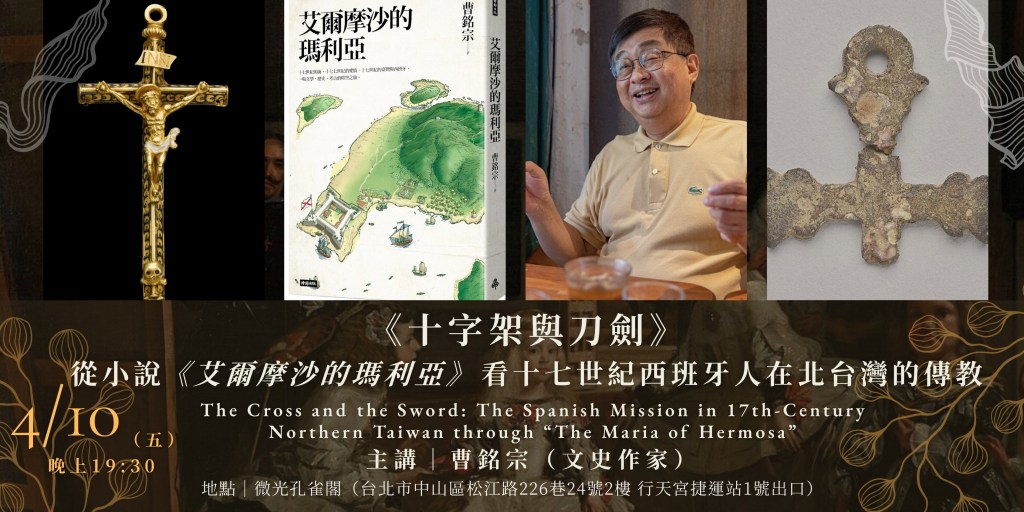
主講:曹銘宗(文史作家)
時間:4/10(五)19:30
地點:微光孔雀閣 (臺北市中山區松江路226巷24號2樓)
內容:
本講座邀請出身臺灣基隆的作家、文化記者、文史研究者─曹銘宗,以他出版的十七世紀西班牙人在台灣為背景的歷史小說 《艾爾摩沙的瑪利亞》為中心,介紹西班牙時代台灣在西班牙時期宗教文化的背景。
1626 年,西班牙帝國由菲律賓馬尼拉出發,航向北台灣,在雞籠(今基隆)建立聖薩爾瓦多城,並於和平島一帶興建諸聖堂,展開台灣歷史上最早的天主教傳教行動。這段歷史僅持續十六年,卻牽動宗教、軍事、貿易與族群關係,構成一段高度複雜、卻長期被忽略的歷史脈絡。
文史作家—曹銘宗以其歷史小說 《艾爾摩沙的瑪利亞》,重新召喚這段被海霧與時間掩蓋的歷史。
小說以十九歲的西班牙青年軍官與原住民女孩為敘事核心,透過兩人之間交織的情感、語言與信仰關係,折射出殖民者與被殖民者之間的權力不對等與文化誤讀。書中反覆出現的聖母意象,呈現傳教士對天國的想像,也映照出原住民社會對死亡、靈魂與異鄉信仰的不同理解。
本場講座中,曹銘宗將分享他如何在史料有限的情況下,結合考古發現、歷史文獻與敘事想像,重構十七世紀北台灣的宗教與生活場景,
講座將深入探討西班牙人在北台灣的傳教、貿易與軍事目的,小說中「信仰」與「文明」如何彼此對峙與交會,以及諸聖堂遺址的現代考古成果,如何為文學小說提供歷史的支點。
透過歷史與文學的交織,本場講座邀請觀眾重新看見北台灣在世界大航海海圖中的位置。
About the Program
This lecture features Cao Mingzong, a writer, cultural journalist, and historical researcher from Keelung, Taiwan, and centers on his historical novel Maria of Hermosa, set during the Spanish period in seventeenth-century Taiwan.
In 1626, Spanish forces sailed from Manila to northern Taiwan, establishing Fort San Salvador in Keelung and initiating the island’s earliest Catholic missionary activities. Though lasting only sixteen years, this period shaped religion, military strategy, trade, and interethnic relations, yet has long remained marginal in historical narratives.
Through his novel, Cao Mingzong reimagines this obscured past, using the relationship between a young Spanish officer and an Indigenous woman to explore faith, power imbalance, and cultural misunderstanding. In this lecture, he discusses how archaeological findings, historical records, and narrative imagination can work together to reconstruct the religious and everyday life of early modern northern Taiwan—inviting audiences to reconsider Taiwan’s place within the maritime world of the Age of Exploration.
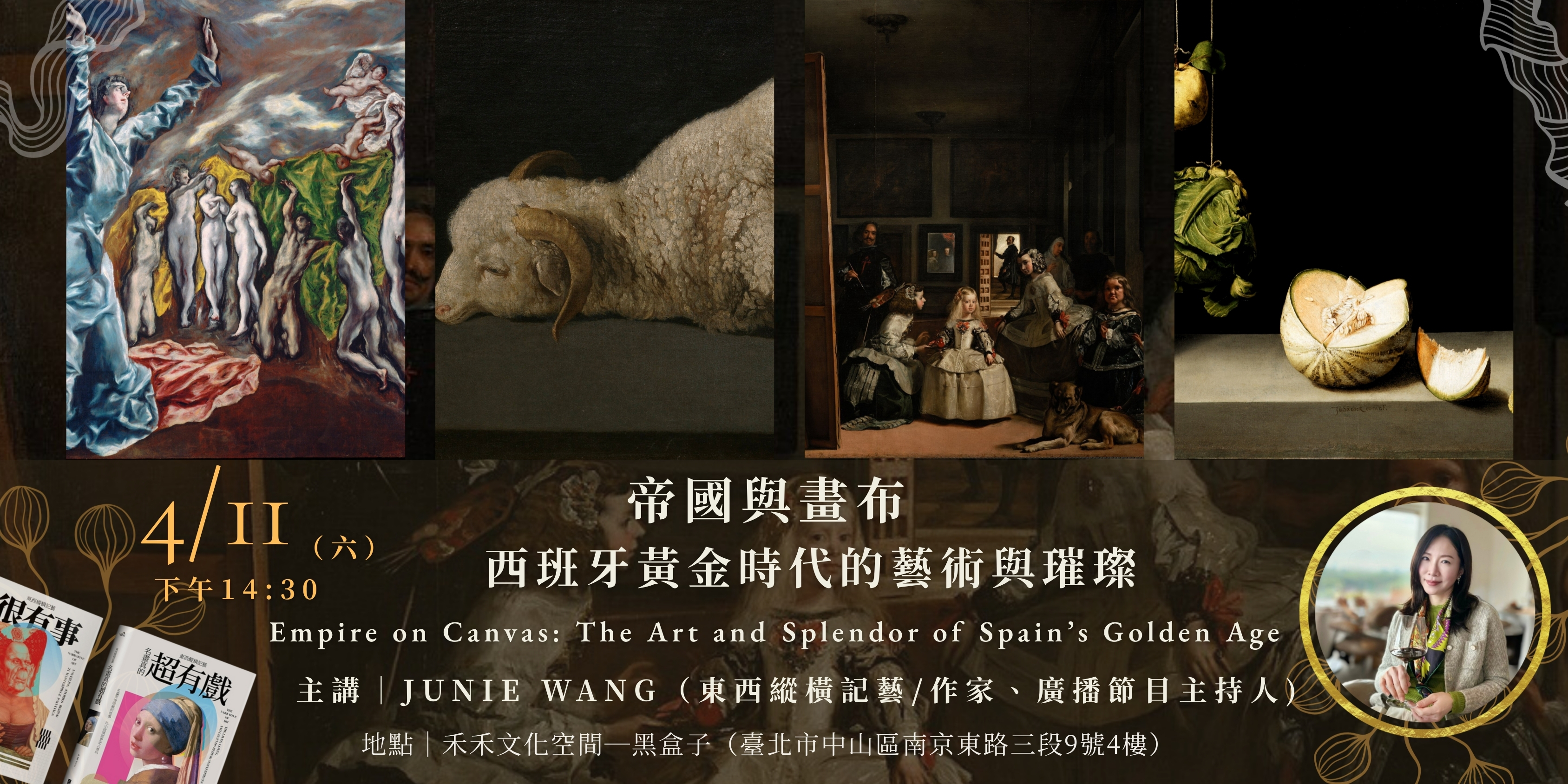
《帝國與畫布》 西班牙黃金時代的藝術與璀璨. Junie Wang 講座
Empire on Canvas: Art and Faith in Spain’s Golden Age
日期:4/11(六)14:30
主講:Junie Wang(東西縱橫記藝/暢銷作家、廣播節目主持人)
地點:禾禾文化空間─黑盒子(臺北市中山區南京東路三段9號4樓)
內容:
提到音樂不能不提政治、文化,而體現一個文化最直觀的藝術便是繪畫。
西班牙的「黃金時代」並非單一風格或純然輝煌的歷史標籤,是一段充滿張力與矛盾的文化時期。
十六至十七世紀,隨著哈布斯堡王朝的擴張,西班牙成為歐洲最具影響力的帝國之一;然而,政治壓力、宗教改革的餘波與社會結構的動盪,也深刻影響了藝術的生產與觀看方式。正是在這樣的背景下,藝術在裝飾或再現之外,甚至成為權力、信仰與個人感受交鋒的地方。
本場講座邀請東西縱橫記藝、藝術策展人與節目主持人、亦是多本藝術暢銷書作者的- Junie Wang 主講, Junie長期致力於將藝術史置回其文化、政治與思想脈絡中加以解讀。講座將從西班牙黃金時代的歷史背景出發,帶領觀眾重新觀看這個時期的重要藝術創作。
從西班牙文藝復興畫家—艾爾·葛雷柯( El Greco) 筆下拉長而扭曲的人物、強烈而不安的宗教情感,到委拉茲奎茲對現實與幻象、權力與凝視之間微妙關係的處理,講座將說明藝術如何反應當時的宮廷政治、天主教教會與社會秩序。
除了繪畫之外,講座亦將觸及建築、與光影的運用,解析其背後所隱含情感。
這些作品既是帝國視覺文化的展演,也是歐洲藝術史的重要轉捩點。
它們顯示藝術如何在服膺權力的同時,保留質疑與詩意的空間;也讓我們理解,「黃金時代」在繁盛與榮耀的象徵之外,同時也是一段文明在矛盾中前行的痕跡。
透過本場講座,觀眾將不只是認識幾位偉大的西班牙17世紀畫家,也會學會如何在觀看中思考:藝術如何被用來建構世界,又如何在光影中透露人性的複雜與深度。
About the Program
To speak of music is inevitably to speak of politics and culture, and among the arts, painting offers the most immediate reflection of a civilization. Spain’s so-called Golden Age was not a single style nor an untroubled moment of splendor, but a period marked by tension and contradiction. In the sixteenth and seventeenth centuries, as the Habsburg Empire expanded, political pressure, religious conflict, and social instability profoundly shaped how art was produced, used, and perceived. Art became not only representation or decoration, but a site where power, faith, and personal experience collided.
This lecture is presented by curator, cultural commentator, and bestselling art author Junie Wang, whose work consistently situates art history within its political and intellectual contexts. Beginning with the historical background of Spain’s Golden Age, the lecture reexamines key artistic developments of the period.
From the elongated, spiritually charged figures of El Greco to Diego Velázquez’s subtle negotiation of reality, illusion, and power, the lecture explores how painting, architecture, and the use of light reveal the emotional and ideological undercurrents of court life, Catholic belief, and social order.
These works stand both as expressions of imperial visual culture and as turning points in European art history, demonstrating how art can serve authority while still preserving ambiguity, critique, and poetic depth. Through this lecture, audiences are invited not only to encounter major Spanish artists, but to reflect on how art constructs worldviews, and how light and shadow expose the complexity of human experience.
四月底. 觸覺 Touch
透過身體、舞蹈與演奏實踐「觸碰」大航海時代
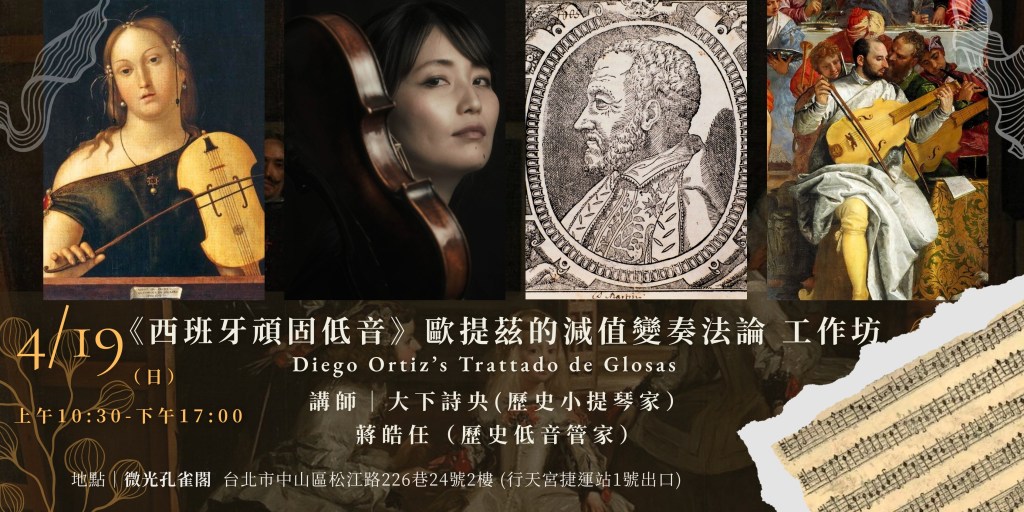
《西班牙頑固低音》 歐提茲的減值變奏法論. 大下詩央 工作坊
Diego Ortiz’s Trattado de Glosas
講師:大下詩央
日期時間:4/19 (日)
10:30-12:30 理論講座
14:00-17:00 實踐工作坊
地點:微光孔雀閣 (臺北市中山區松江路226巷24號2樓)
內容:
《西班牙頑固低音—歐提茲的減值變奏法論》,由微光古樂集音樂總監—大下詩央主持,結合音樂史、演奏技法與即興實踐的體驗講座工作坊。
1553 年,西班牙作曲家與維奧爾琴家—狄亞哥‧歐迪茲(Diego Ortiz)在羅馬出版了 《減值變奏論 Trattado de Glosas sobre clausulas y otros generos de puntos en la musica de violones》,此書不僅是第一部專注於弓弦樂器裝飾及變奏技法的印刷樂書,亦是歐洲早期器樂即興演奏的核心文獻之一。
在《減值變奏論》中,歐迪茲詳細介紹了如何在當時流行的頑固低音上進行裝飾變奏,即所謂 glosas(減值變奏),並透過 recercadas(利恰卡爾)探討旋律與對位的即興;這些實例對後來十七、十八世紀低音即興和作曲技術具有深遠影響。
本次工作坊的核心目的,是讓參與者透過閱讀原始文獻片段、技法示範與實際演奏練習,從早期巴洛克的裝飾奏出發,用歐迪茲的範例,學習如何在頑固低音之上「即興」大下詩央將:
- 介紹 《減值變奏論》 的年代風格, 分析譜例與示範技法
- 示範 利恰卡爾recercadas 及減值變奏 glosas的演奏與即興方式
- 指導參與者親身演奏這些片段,體驗在頑固低音中創造自由與表現力的手法
無論是初學者,還是進階演奏者希望深化對早期巴洛克頑固低音即興演奏法的理解,本工作坊都將提供完整精彩的音樂理論與實踐,親身操作感受16世紀西班牙的即興變奏藝術!
*工作坊將提供大鍵琴伴奏。
About the Program
This lecture-workshop is led by Shio Ohshita, Music Director of The Gleam Ensemble, and combines music history, performance technique, and hands-on improvisation.
In 1553, Spanish composer and viol player Diego Ortiz published Trattado de Glosas in Rome, one of the earliest printed treatises devoted to ornamentation and variation for bowed string instruments, and a foundational source for early instrumental improvisation in Europe.
Ortiz explains how to create glosas (diminutions) over ostinato bass patterns and explores melodic and contrapuntal improvisation through recercadas. These techniques deeply influenced seventeenth- and eighteenth-century basso continuo practice and compositional thinking.
Through close reading of original examples, live demonstrations, and guided playing, participants will learn how to improvise freely over an ostinato bass using Ortiz’s methods. The workshop is open to both beginners and advanced players interested in experiencing the expressive freedom of sixteenth-century Spanish improvisation.
A harpsichord accompaniment will be provided.
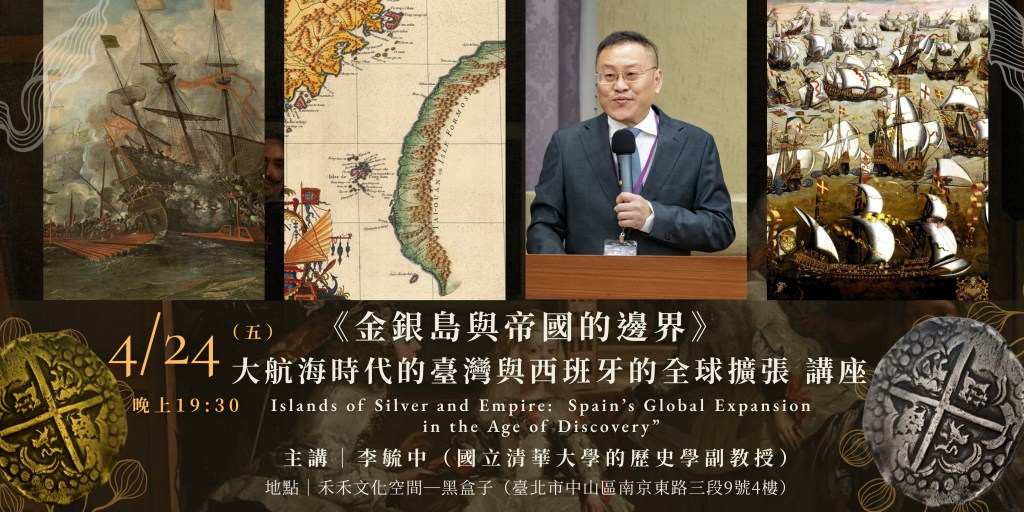
《金銀島與帝國的邊界》 大航海時代的臺灣與西班牙的全球擴張. 李毓中講座
Islands of Silver and Empire: Taiwan and Spain’s Global Expansion in the Age of Discovery”
日期:4/24(五)19:30
主講:李毓中(國立清華大學的歷史學教授)
地點:禾禾文化空間─黑盒子(臺北市中山區南京東路三段9號4樓)
內容:
在十七世紀大航海時代的浪潮中,臺灣是處於多國勢力交會的重要節點。
十六、十七世紀的歐亞與太平洋海域,西班牙憑藉其全球帝國體系,在1626–1642年間於北臺灣建立「聖薩爾瓦多城」與諸聖堂等據點,展開宗教傳播與海上貿易活動。
在十七世紀大航海時代的海洋想像中,「金銀島」與「女人島」等傳說在歐洲人的心中長期存在,這些故事既反映了財富與未知的吸引力,也是當時世界觀與地理知識未明的文化產物。
17世紀以前,受馬可波羅等旅行敘述影響,葡萄牙與西班牙的航海家甚至在世界地圖上標示出接近日本附近的金銀島位置,視其為東方財富的象徵,而荷蘭人也曾在1639年和1643年派艦遠航搜尋這一目標海域,但始終未能找到確切島嶼。
這類寓言式的記載在當時的航海誌中出現,展現出歐洲人對亞洲與太平洋未知海域既充滿幻想又帶有想像性敘事的文化脈絡。
本場講座由台灣研究西班牙史的專家、國立清華大學歷史學副教授—李毓中主講,李教授的研究長期橫跨海洋史、世界史與西班牙史,其著作與編譯包括 《西班牙人在臺灣(1626–1642)》 以及多冊 《臺灣與西班牙關係史料匯編》,
致力於將散見於西班牙、菲律賓等地檔案的原始史料重新整理、翻譯與系統性呈現,補足早期臺灣史料中的缺口。
講座將從西班牙帝國在亞洲的整體擴張脈絡出發,結合十七世紀的歷史文獻與古地圖介紹,李教授也將談及大航海時代流傳於歐洲航海傳說中的「金銀島與女人島」是否為台灣等故事,這些傳說從古羅馬直到十七世紀的西班牙與葡萄牙航海者之間流傳,反映了當時航海文化與帝國擴張如何影響歐洲人對遠東太平洋海域的幻想與期待。
About the Program
During the Age of Maritime Exploration in the seventeenth century, Taiwan was a key crossroads where multiple imperial powers intersected. Between 1626 and 1642, Spain established Fort San Salvador and religious sites in northern Taiwan, using the island as part of its global imperial, missionary, and maritime trade networks.
At the same time, European maritime imagination was shaped by legends such as the Islands of Gold and Silver and the Island of Women, mythical lands believed to lie near Japan. Influenced by travel accounts from Marco Polo onward, Portuguese, Spanish, and later Dutch expeditions even marked these islands on maps and launched voyages in search of them, revealing how limited geographic knowledge and imperial desire fueled powerful fantasies about the Pacific.
This lecture is presented by Yu Chung Lee, Associate Professor of History at National Tsing Hua University and a leading scholar of Spanish–Taiwanese history. Drawing on archival research and early maps, he examines Spain’s expansion in Asia and discusses how myths such as the Gold and Silver Islands shaped European perceptions of Taiwan and the Far East, offering insight into how exploration, empire, and imagination were deeply intertwined.
文藝復興舞蹈家/聲樂與音樂史理論家─ 奧贊.卡拉格茲來台系列
Ozan Karagöz- Renaissance Dance and Polyphony workshop
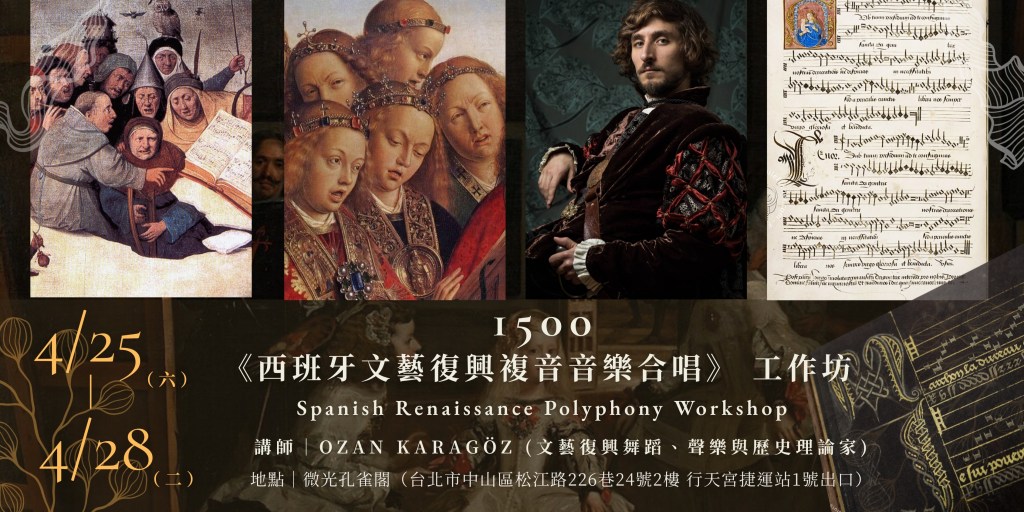
《1500 西班牙文藝復興複音音樂合唱與古譜視讀》 . Ozan Karagöz工作坊
Spanish Renaissance Polyphony Workshop
日期時間:
4/25
10:00-12:00 文藝復興合唱初階班(梯次1)
4/26
10:00-12:00 文藝復興合唱初階班(梯次2)
4/27
10:00-13:00 文藝復興合唱進階班(梯次1)
4/28
10:00-13:00 文藝復興合唱進階班(梯次2)
講師:奧贊.卡拉格茲 (Ozan Karagöz) 土耳其文藝復興舞蹈家、聲樂家與理論家
地點:微光孔雀閣((臺北市中山區松江路226巷24號2樓))
內容:
《1500 西班牙文藝復興複音音樂合唱與古譜視讀》工作坊由巴塞爾古樂學院畢業的古樂家/歷史舞蹈家暨文藝復興音樂學者-奧贊.卡拉格茲 (Ozan Karagöz) 帶領學員走入十六至十七世紀初西班牙宮廷的絕美複音音樂合唱世界。
合唱與古譜研讀活動分為初階班與進階班:
活動分成兩天初階、兩天進階,今從簡易動人的文藝復興合唱曲到複雜複音大作彌撒曲,
參加者可自行依程度選擇想要的梯次。活動涵蓋理論的解說和文藝復興古譜與手抄譜的研讀,學習視讀文藝復興的譜號、節奏與節拍,最後會盡可能從文藝復興古譜進行合唱呈現。
本工作坊聚焦於西班牙文藝復興時期的複音合唱文化,從 1490 年代的宮廷歌本出發,逐步探討和實唱西班牙作曲家等彌撒與世俗作品,同時學員將親身體驗研讀文藝復興時代的古譜。
十五至十七世紀的複音音樂是無伴奏合唱(a cappella)的黃金時期,其聲部之間的 對位、模仿與和聲結構 探討了多個獨立旋律如何在同一時間交織與互動,並以拉丁文為歌詞。
這些作品經常採用從世俗音樂衍生的主題旋律,再透過彼此獨立的樂句與節奏進行模仿與發展,是文藝復興音樂語法的精華所在。
在活動中,我們將聚焦於代表性的西班牙複音作曲家,包括被譽為西班牙文藝復興最偉大作曲家之一的維多利亞( Tomás Luis de Victoria),另有 Cristóbal de Morales 與 Alonso Lobo 等人的彌撒與經文歌和世俗作品,親身用嗓音,探索是對文藝復興時期音樂觀念、聲音語法與精神世界的一次深刻體驗。
About the Program
This workshop is led by Ozan Karagöz, an early-music musician, historical dancer, and Renaissance music scholar, Participants are invited to enter the rich world of Spanish Renaissance polyphonic choral music from the late 15th to the early 17th century.
The workshop is offered at beginner and advanced levels, each spanning two days. Participants may choose according to experience, progressing from accessible Renaissance choral works to more complex polyphonic Mass movements. Sessions combine practical singing with guided reading of Renaissance printed and manuscript sources, introducing historical clefs, rhythmic systems, and mensural notation. Whenever possible, music will be sung directly from original early scores.
Focusing on the Spanish Renaissance choral tradition, the workshop explores sacred and secular repertoire beginning with late-15th-century court songbooks. Participants will experience firsthand how Renaissance polyphony—an a cappella art form at its height, interweaves independent vocal lines through counterpoint, imitation, and harmonic balance, often based on themes drawn from secular music.
Repertoire will include works by leading Spanish composers such as Tomás Luis de Victoria, Cristóbal de Morales, and Alonso Lobo. Through singing and score reading, participants will gain a deeper understanding of Renaissance musical thought, vocal practice, and the spiritual world embedded in this extraordinary polyphonic tradition.
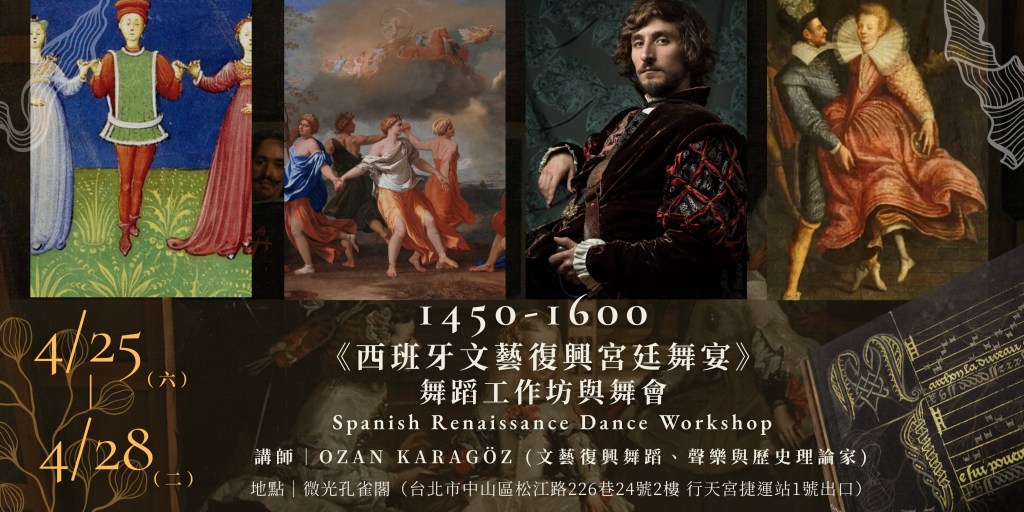
《1450-1600 西班牙文藝復興舞蹈》 Ozan Karagöz工作坊
Spanish Renaissance Dance Workshop
日期時間:
4/25
14:30-16:30 文藝復興舞蹈初階班(梯次1)
19:30-21:30 文藝復興舞蹈初階班(梯次2)
4/26
14:30-16:30 文藝復興舞蹈初階班(梯次3)
19:30-21:30 文藝復興舞蹈初階班(梯次4)
4/27
14:30-17:30 文藝復興舞蹈進階班(梯次1)
4/28
14:30-17:30 文藝復興舞蹈進階班(梯次2)
19:00 文藝復興舞會
講師:奧贊.卡拉格茲 (Ozan Karagöz) 土耳其文藝復興舞蹈家、聲樂家與理論家
地點:微光孔雀閣(臺北市中山區松江路226巷24號2樓)
內容:
在十五至十七世紀初的歐洲宮廷中,舞蹈是一套結合身體訓練、社交禮儀與政治象徵的文化語言。
姿態的控制、步伐的節奏、與他人互動的距離與視線,皆構成了宮廷社會中「如何成為一個被看見的人」的重要規範。西班牙文藝復興舞蹈正是在這樣的文化背景下,形塑出獨特而精緻的身體美學。
文藝復興舞蹈工作坊分為初階班(2h)與進階班(3h):活動分成兩天四場初階、兩天各一場進階,從簡易步伐的文藝復興舞蹈到需要隊形的進階舞步,參加者可自行依程度選擇想要的梯次。
本系列工作坊由2023年來台演出的土耳其歷史舞蹈家- 奧贊.卡拉格茲(Ozan Karagöz)帶領,Ozan Karagöz 畢業於瑞士巴塞爾古樂學院(Schola Cantorum Basiliensis)長期從事文藝復興與巴洛克時期音樂與歷史舞蹈的研究與實踐。
活動將於週五晚間至週二展開,內容涵蓋歷史舞蹈、隊形、和舞蹈記譜法入門,以及舞蹈在西班牙和南義大利宮廷的社交功能。教學脈絡將從約 1450 年 皮亞千查(Domenico da Piacenza)所建立歷史上最早的舞蹈文獻出發,理解早期宮廷舞蹈如何以比例、重心與節奏為核心。
在此基礎上,活動將聚焦於十五至十六世紀廣泛流行於西班牙及其南方屬地拿波里的代表舞曲,包括莊重而典雅的帕望舞(Pavane),以及以"西班牙旋律La Spagna “為基礎衍生出的 Spagnoletta舞蹈。這些舞曲在義大利舞蹈大師- Fabritio Caroso 與 Cesare Negri 的舞蹈書文獻中皆有不同版本的編舞與節奏處理,呈現出伊比利風格如何透過音樂與舞蹈在歐洲宮廷間流動與再創造。
在會後將於4/28(二)晚間19:00 舉辦一場開放報名的文藝復興宮廷舞會。
舞會將由微光古樂集樂師提供即時樂器伴奏,讓參與者在真實的聲響情境中,體驗舞蹈與古樂器演奏交織而成的西班牙文藝復興宮廷氛圍。
About the Program
In European courts from the 15th to the early 17th century, dance functioned as a refined cultural language combining bodily discipline, social etiquette, and political symbolism. Control of posture, rhythm, spatial awareness, and eye contact shaped how one was seen and recognized within court society. Spanish Renaissance dance developed within this context, forming a distinctive and elegant bodily aesthetic.
This Renaissance Dance Workshop is offered at beginner (2h) and advanced (3h) levels, spread across multiple sessions over several days. Participants may choose classes according to their experience, progressing from basic steps to structured group choreographies.
The workshop is led by Ozan Karagöz, a Turkish historical dancer and researcher, and a graduate of the Schola Cantorum Basiliensis, who specializes in Renaissance and Baroque dance practice.Classes cover historical steps, formations, and an introduction to dance notation, with a focus on courtly dance culture in Spain and southern Italy. The teaching traces early dance theory from Domenico da Piacenza (c.1450) and centers on key Renaissance dances such as the stately Pavane and Spagnoletta, derived from the widely circulated La Spagnamelody, as documented by dance masters Fabritio Caroso and Cesare Negri.
The series concludes with a Renaissance Court Ball on April 28 (Tue) at 19:00, accompanied live by musicians from The Gleam Early Music Ensemble, allowing participants to experience Spanish Renaissance dance within an authentic musical setting.
Cesare Negri, Capella de Ministrers, Carles Magraner
 微光古樂集
微光古樂集 
你必須登入才能發表留言。